
Oct. 21, 2026
You might think that Bloom’s Taxonomy makes the concepts of learning or understanding complicated enough, but the model is actually more complicated than I previously let on—and I would argue that the reality is even more complicated than the full model suggests!
Here’s the 2001 revision of the model, which still breaks learning down into 6 levels of generally increasing complexity…
- Remembering
- Understanding
- Applying
- Analyzing
- Evaluating
- Creating
If you’re paying attention, you’ll notice that the 5th and 6th levels are swapped in the revised version. Additionally, the levels are now framed as verbs. (This is due to how educators write learning objectives, which is one of the primary uses of the taxonomy.)
Previously, I described the levels in a general “overview” way. In actuality, scholars have broken down each of the six levels into sub-components. For example…
- Remembering breaks down into identifying and recalling (think “matching” vs. “fill-in-the-blank” test questions).
- Understanding breaks down into several dimensions, including classifying, comparing, explaining…
- Evaluating breaks down into checking and critiquing.
- Et cetera
Additionally, the different levels can be mapped against different types of knowledge (e.g., factual vs. procedural).
Here’s a 2D representation of this idea, with example tasks in each cell (courtesy of Claude):
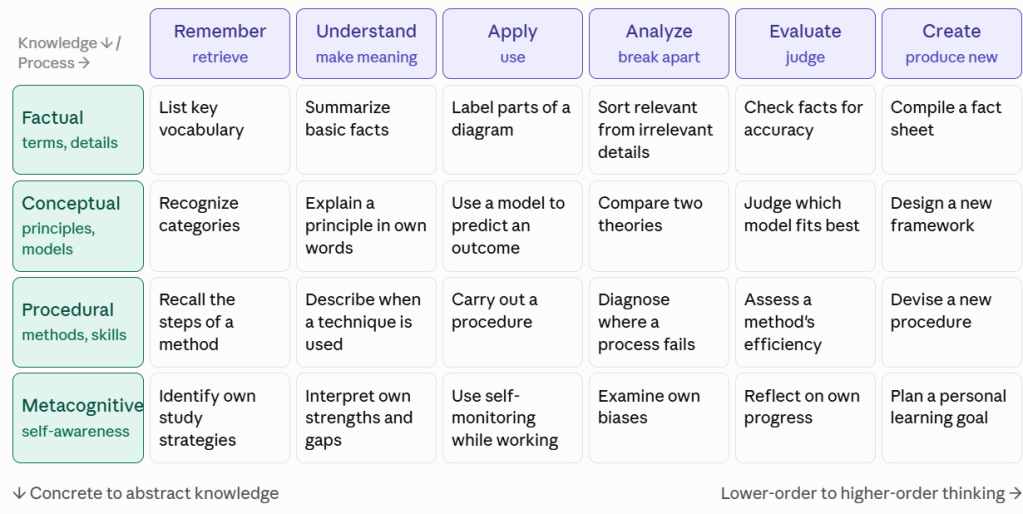
(For details on the actual revised model from the scholars themselves, check out Anderson & Krathwohl [2001].)
But even within this more nuanced framework, I would argue that there are degrees of understanding at each level and its component dimensions, on a spectrum from shallow to deep.
For example, in the Remembering/Knowledge level, consider a person’s recall of facts in a subject area. Their extent of recall could be…
- Shallow (e.g., remember a few introductory key terms)
- Deep (e.g., remember many advanced terms)
- Or anywhere in between
Or in the Understanding/Comprehension level, consider a person’s ability to explain some mechanical process, such as how a lightbulb works. Again, their extent of explanatory ability could be…
- Shallow (e.g., vaguely describe the general process)
- Deep (e.g., describe the process in great depth and in multiple ways)
- Or anywhere in between
This is called explanatory depth.
I’m not the only person who has thought of this, by the way. For example, Biggs & Collis (1982) published a model of what is essentially depth of learning, which they map onto cognitive developmental stages.
Additionally, the concept of explanatory depth is the subject of an entire research literature—the illusion of explanatory depth (i.e., the study of how we typically LACK the ability to explain causal processes with as much depth as we think we can).
It doesn’t look as clean, but I had Claude add a third dimension to the previous image to represent depth of understanding. (Appropriately, if the other two axes represent length and height, then this third dimension represents literal depth.)
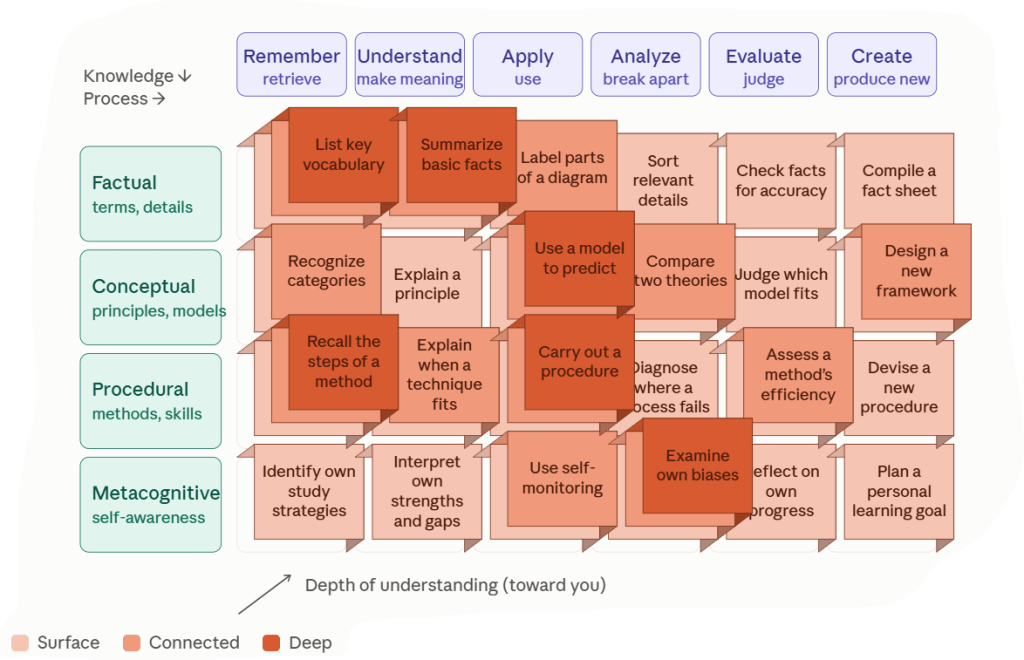
This is an attempt to illustrate how different demonstrations of knowledge can occur with varying amounts of depth; therefore, it is not as simple as higher-order processes always representing greater depth of understanding.
(Granted, I suspect that higher-order levels such as Creating generally do correspond to deeper understanding than lower-order levels such as Remembering; my argument is only that it’s not guaranteed.)
In this way, I view Bloom’s Taxonomy merely as six types of activities relating to knowledge. This argument doesn’t make the framework any less useful, but it does reveal a clear problem…
A person could technically demonstrate “understanding” in all six of Bloom’s levels while still having basically no idea what they’re talking about.
Reflecting on my own learning process, as well as what I observe in others, it seems to me that “shallow mastery” is more common than we’d like to believe, and it’s far less common than deep understanding.

